THE CALL.
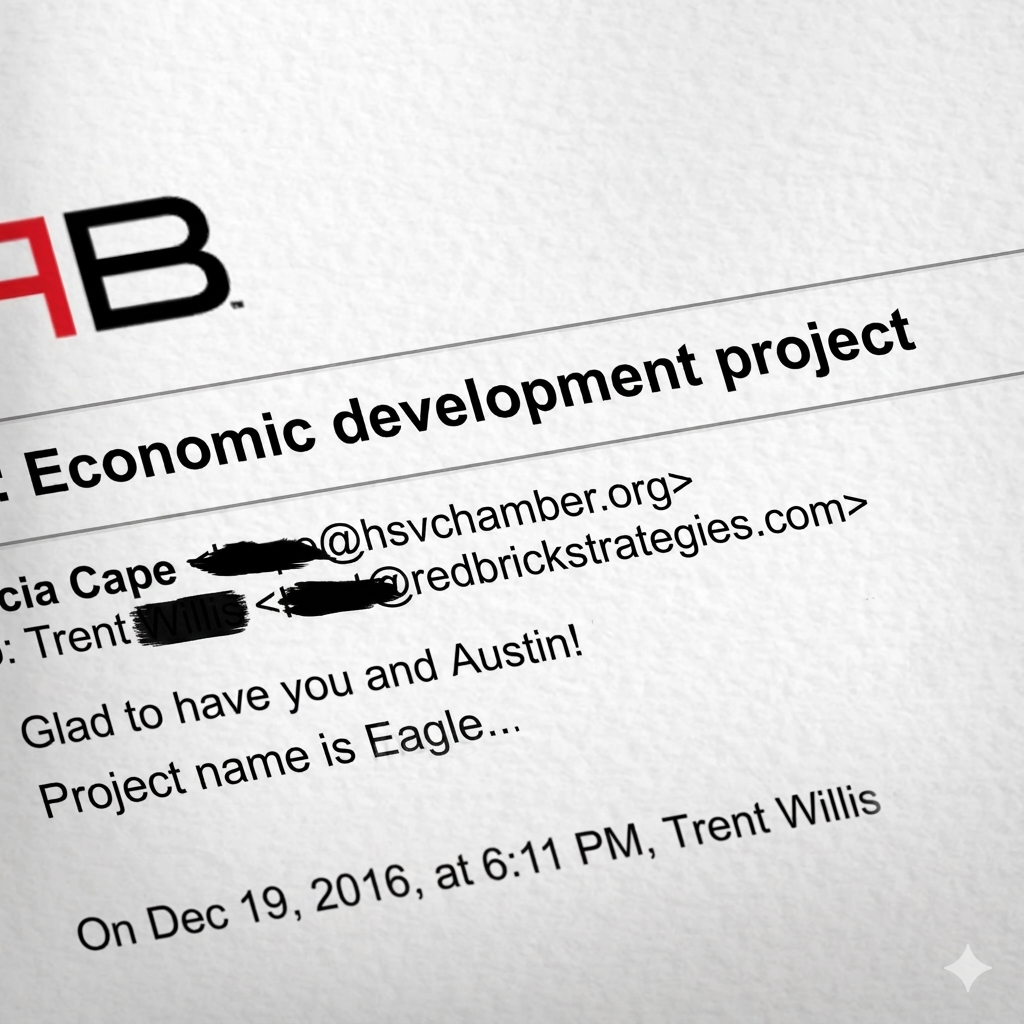
The email came in December 2016 from Lucia Cape, SVP for Economic Development at the Huntsville/Madison County Chamber. The subject line gave nothing away. The project was described as “very exciting.” A follow-up was shorter: “This calls for a face-to-face. Magic is definitely on the menu.”
The face-to-face came with an NDA. Behind the NDA was Blue Origin — Jeff Bezos’s spaceflight company — quietly evaluating Cummings Research Park as the production site for its BE-4 rocket engine. The engine that would power the United Launch Alliance Vulcan rocket. The engine that would push the first stage of Blue Origin’s own New Glenn vehicle off the pad.
From that meeting forward, the company’s name was never typed in an email. The project had a single word for everything: Eagle.
THE BRIEF.
The ask had two parts.
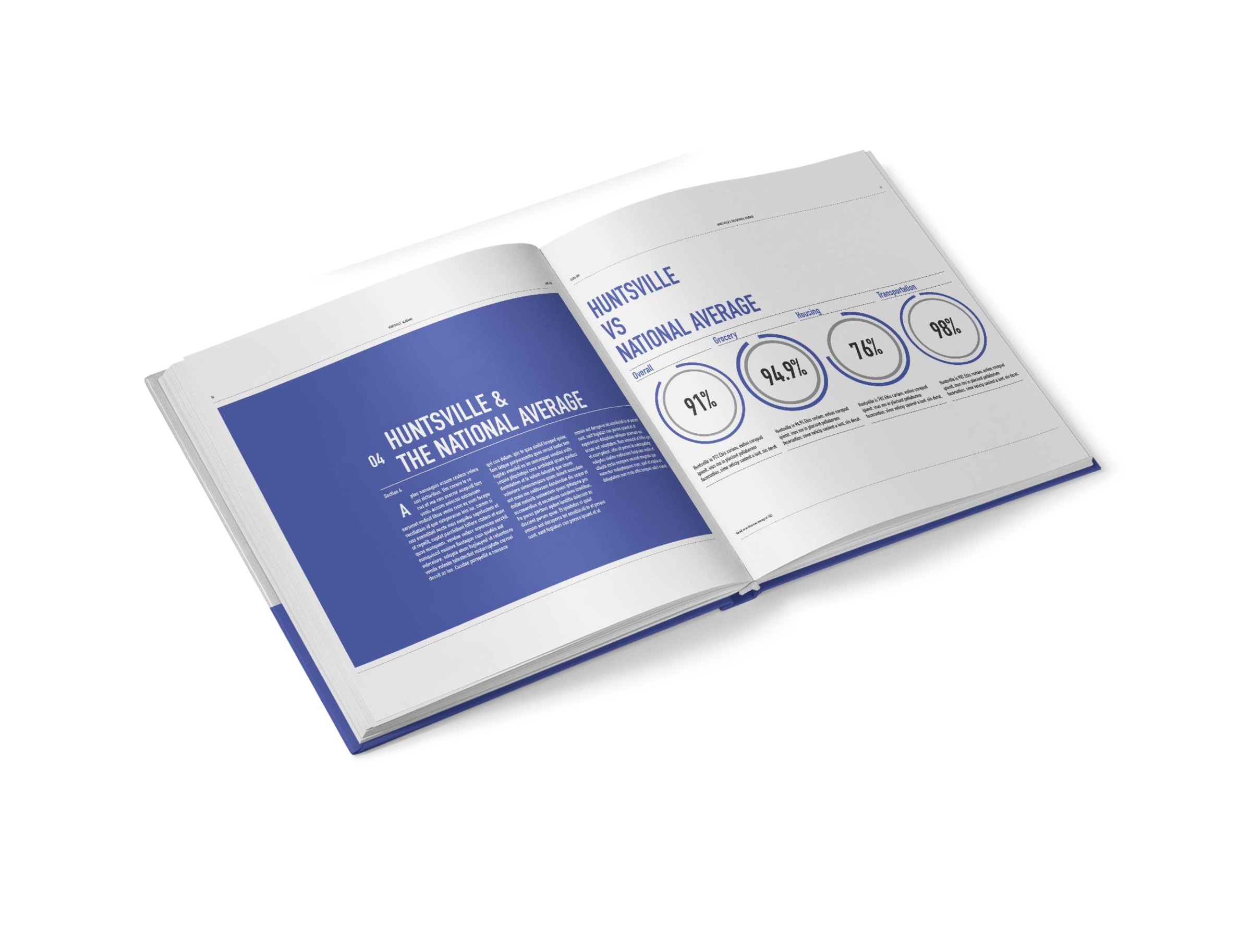
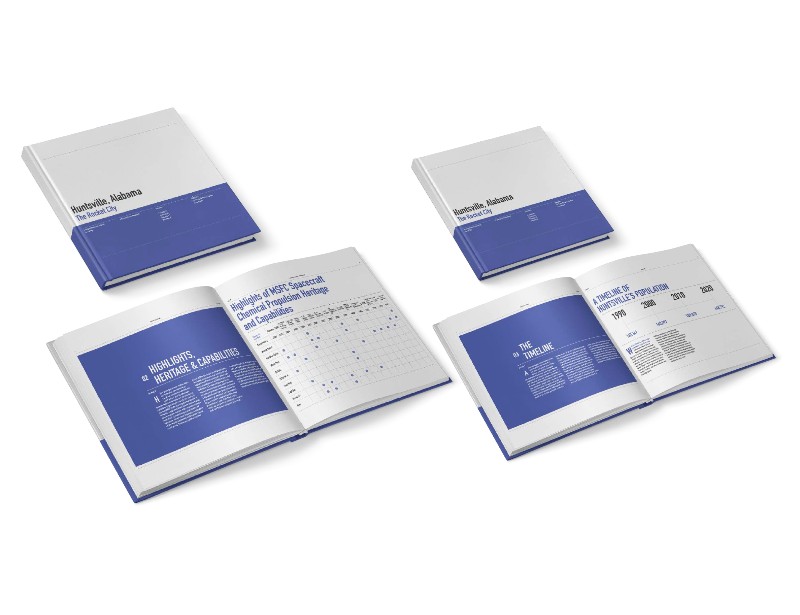
The first was the materials Blue Origin’s site selection team would receive during the formal recruitment — booklets, proposal documents, data presentations. The dossier a decision-maker reads the night before they choose a city.
The second was a film. Not a promotional video. A film that could put Huntsville’s aerospace lineage in front of someone who already knew what a rocket engine was — who had built one — without being condescending about the history or reverential about it either. A film that could survive the NDA and stand as a community document once the news was public.
The constraint that shaped everything: nothing in any of the materials could name Blue Origin, reference the BE-4 engine, or indicate in any traceable way what the project was actually for. The people reading them would know. Everything else had to be written as if it didn’t.
THE MATERIALS.
I started the design work by studying one document: NASA’s 1975 Graphics Standards Manual, produced by the firm Danne & Blackburn. Still the most coherent identity system ever built for an American institution. Restrained type. Generous white space. Data formatted like instruments, not marketing collateral.
That discipline became the discipline of the Eagle materials. Where NASA’s manual specified its own typefaces and color field, I quietly substituted Blue Origin’s — without annotation, without calling attention to it. A Blue Origin engineer who picked up these booklets would register something familiar without being able to place it. That was the intent.
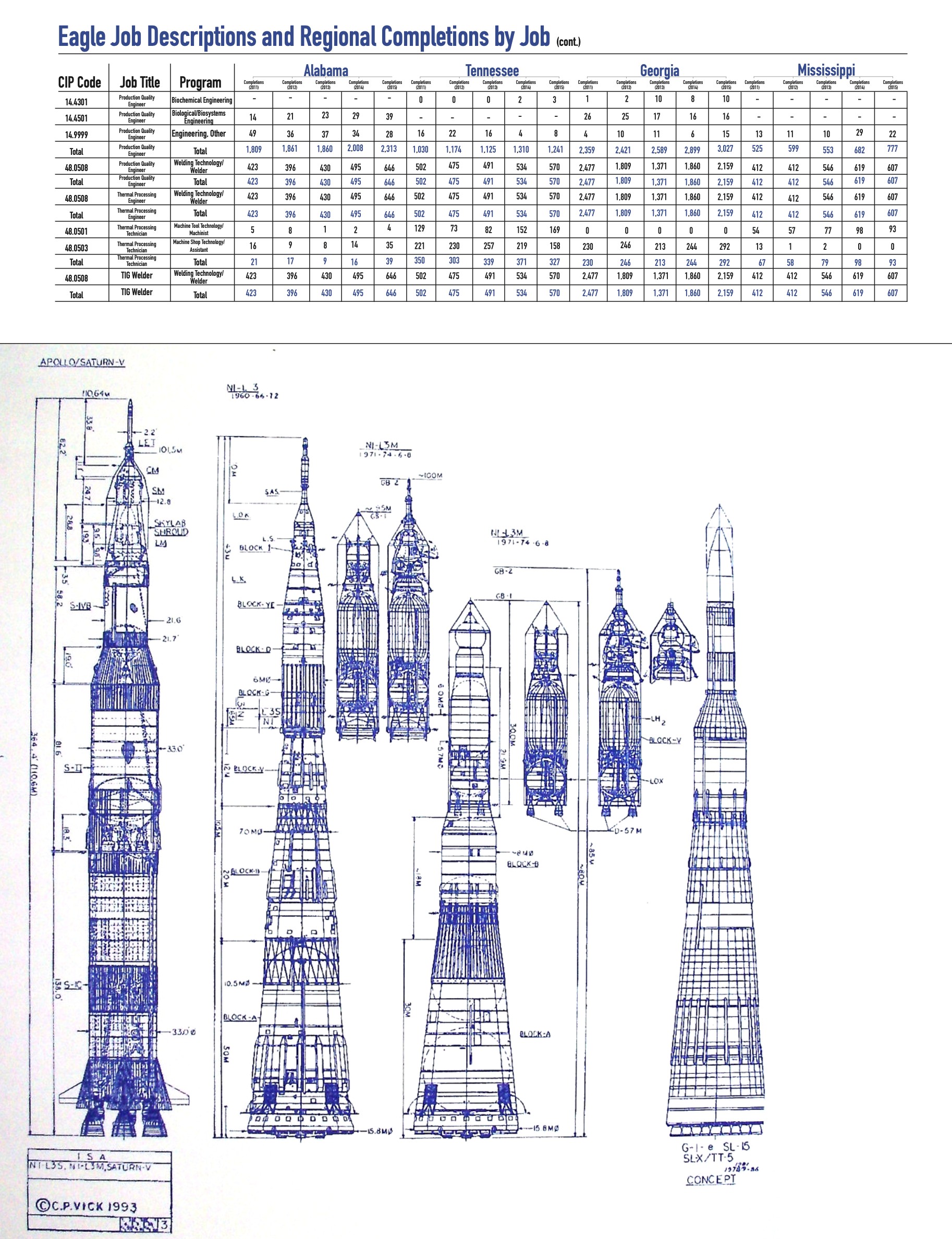
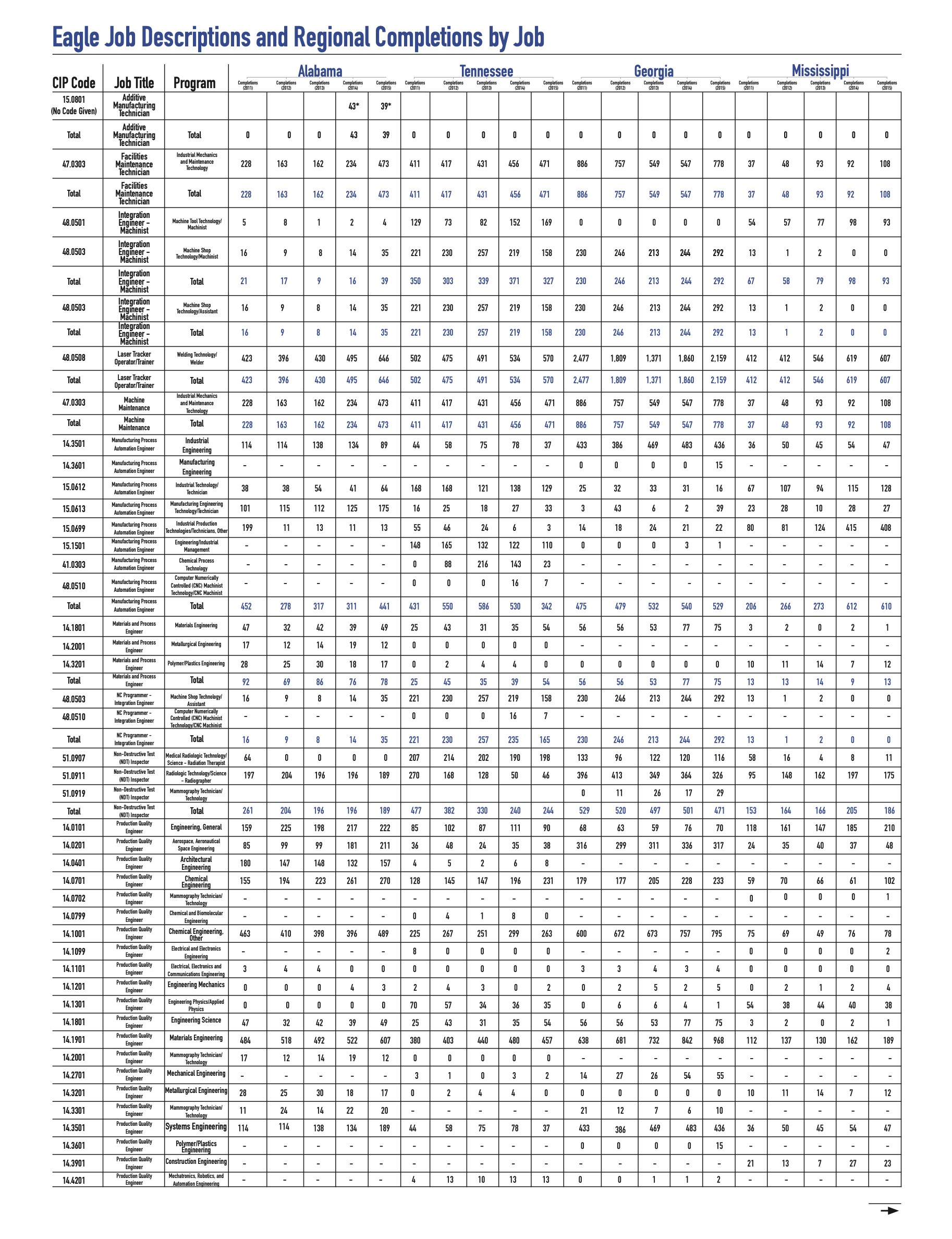
Every page was designed so a senior engineer could open it, find the data point they needed, and trust the city the data described. Workforce completions mapped across four states. Regional manufacturing capacity. Propulsion heritage running back to the V-2 program. Every table was built to be read, not scanned.
For the largest data sets, I produced oversized addendum sheets printed as blueprints — deep blue stock, white line — alongside reproductions of original Apollo/Saturn V engineering drawings from the Marshall Space Flight Center archive. Handled in person, they felt like documents recovered from a mission briefing room — not marketing materials, but primary sources. No explanation was necessary. The argument was physical: here is what we have built. Here, specifically, is who built it.
THE FILM.
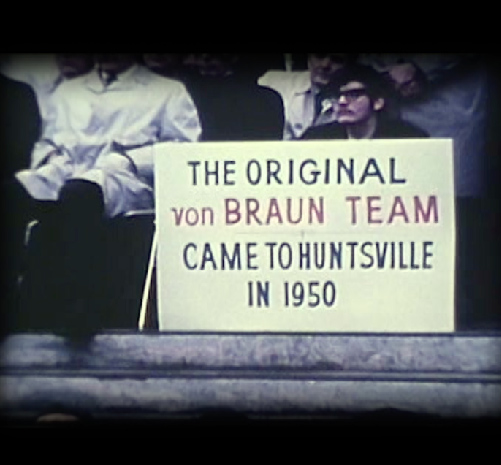
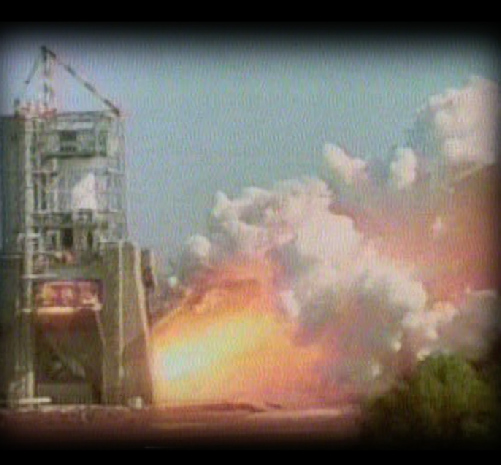
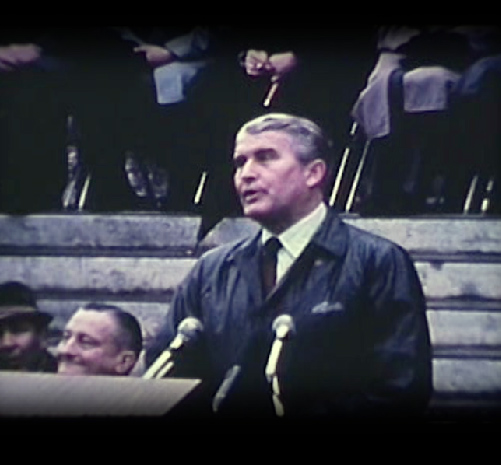
Welcome to Rocket City, USA was the largest production I had undertaken. Logistics required clearances and scheduling coordination across federal agencies, the U.S. Armed Forces, two universities, multiple private aerospace companies, and people whose calendars do not bend easily.
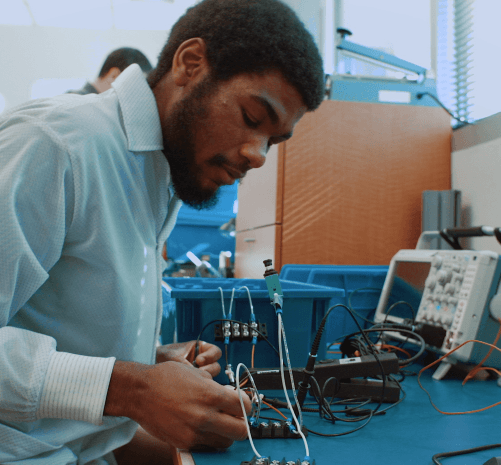
Every interview subject was told only that the project was a film about Huntsville’s role in America’s space program. The Blue Origin connection stayed inside the NDA. They showed up anyway — because the story was true regardless of who was about to hear it.
NASA astronaut and Huntsville native Dr. Jan Davis spoke on camera. A crew listened in as ground controllers in Huntsville communicated in real time with the International Space Station. UAH professor Ross Cortez walked through research into dilithium-based propulsion that could reduce the cost of a Mars mission by three-quarters. Dozens of engineers, students, and researchers from across the aerospace community told the same story from different angles.
The film was shot in the same register as the bid materials — unhurried, observational, confident enough to let the spaces and the people speak without narrator or text overlays explaining what you were looking at. Huntsville didn’t need the film to establish its aerospace credentials. Blue Origin already knew about Redstone Arsenal, Marshall Space Flight Center, and Cummings Research Park. What the film needed to show was that the legacy wasn’t a museum piece. That the engineers were still here. That their successors were already working on what comes next.
THE ANNOUNCEMENT.
The bid materials were delivered in early March 2017. The Chamber walked them into the room. My part of the work was done.
On June 26, 2017, leaders from across Alabama gathered under the Saturn V at the U.S. Space and Rocket Center — the same rocket that Huntsville had built engines for half a century earlier — to make the announcement. Blue Origin was coming to Huntsville. The BE-4 engine — the engine that would eventually push the New Glenn off the pad and power the Vulcan — would be manufactured in the city that manufactured the F-1. Blue Origin committed to a facility investment north of $200 million and more than 300 high-skill jobs in Cummings Research Park. From the first NDA meeting to the announcement, not a word leaked.
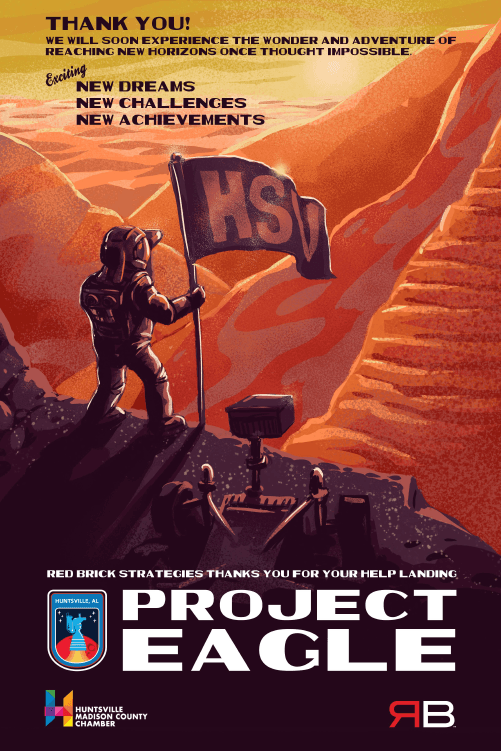
The poster was my thank-you to the Chamber team — the people who had spent months referring to a rocket company only as Eagle.
THE DISCIPLINE.
Eagle was never going to be a project anyone could talk about in real time. The win is public. The work is not. That is how economic development at this scale operates — and it is the condition under which all of these materials were made.
What the Eagle work demonstrates is a specific discipline: when the audience is expert, the work has to be expert. You cannot impress a rocket engineer with marketing language. You can impress a rocket engineer with accurate data, presented clearly, by people who understood what they were presenting.
Welcome to Rocket City, USA works by the same logic. It doesn’t tell the audience that Huntsville is a great place to build rocket engines. It shows the people who are already doing it and trusts the audience to draw the obvious conclusion. The Eagle materials didn’t win Blue Origin for Huntsville — the city’s decades of aerospace infrastructure did that. What the materials did was make sure nothing got in the way of that story landing.